Regional Licensing Evolutions Reshape Software Strategies for Digital Table Games
Written by Mara Lange · Nov 5, 2026
Regional Licensing Evolutions Reshape Software Strategies for Digital Table Games
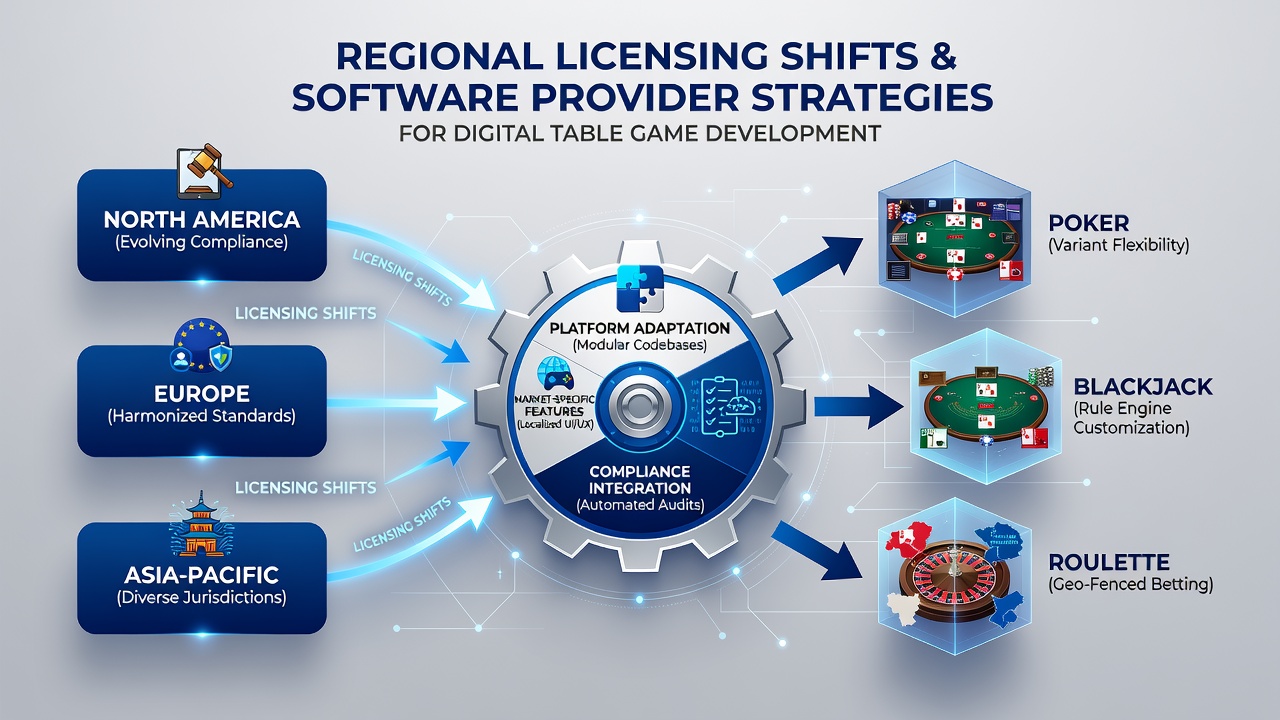
Regional licensing frameworks continue to evolve across major markets, and these changes directly influence how software providers approach digital table game development. Providers must navigate varying requirements for game certification, player protection protocols, and technical standards that differ by jurisdiction. Data from industry reports shows that adaptation often begins with modular design approaches, allowing teams to adjust core mechanics for specific regional rules without rebuilding entire platforms from scratch.
Key Licensing Shifts Across Jurisdictions
North American states have introduced updated certification processes for online table games in recent years, while European regulators emphasize interoperability standards that affect how games integrate with local payment and identity systems. Observers note that providers respond by investing in flexible backend architectures, which support rapid updates when new rules emerge. In Asia-Pacific regions, licensing bodies have tightened controls on game randomness and audit trails, prompting developers to incorporate advanced logging features early in the design phase.
These variations create distinct pathways for market entry. Software teams frequently prioritize jurisdictions with streamlined approval timelines first, then expand features to meet more complex requirements elsewhere. Research indicates that companies maintaining dedicated compliance teams achieve faster turnaround on updates, particularly when regulations change mid-development cycle.
Strategic Adaptations in Development Pipelines
Software providers have adjusted their workflows to include region-specific testing modules that run parallel to core development. This structure allows simultaneous builds for multiple markets, reducing delays when licenses expand or renew. Experts have observed that collaboration with local testing labs becomes a standard step, since each authority maintains unique evaluation criteria for table game variants like blackjack, roulette, and poker derivatives.

Resource allocation patterns show increased focus on reusable components for player interface customizations, such as language localization and responsible gaming prompts. Figures from gaming associations reveal that providers allocating 20-30 percent of project budgets to compliance-related features report smoother license approvals. Integration with third-party verification services also rises, as regulators in several markets now require independent audits of random number generators and payout calculations.
Impact on Innovation and Feature Rollouts
Table game innovation faces constraints when licensing rules limit certain mechanics or visual elements. Providers therefore segment their roadmaps, introducing advanced features like live dealer synchronization or multi-player tournament modes only in regions that permit them. Case examples demonstrate that phased releases help maintain momentum while awaiting approvals elsewhere, and this approach preserves development velocity without violating local statutes.
November 2026 marks a notable deadline in several Canadian provinces where updated digital gaming regulations take effect, requiring enhanced data encryption standards for all table game software. Providers tracking these timelines have already begun incorporating the necessary security layers, which positions them for quicker certification once the rules activate. Similar scheduled reviews appear in select Australian states, creating predictable windows for strategy adjustments.
Collaboration Patterns with Operators and Regulators
Partnership models between software providers and operators have shifted toward joint compliance planning sessions. These meetings focus on aligning game features with operator-specific license conditions, which vary even within the same country. Industry organizations such as the European Gaming and Betting Association publish guidelines that help standardize certain technical requirements, yet regional differences persist.
Providers also engage directly with regulatory bodies like the Nevada Gaming Control Board during early development stages, seeking pre-approval feedback on proposed mechanics. This proactive dialogue reduces revision cycles and supports more accurate project forecasting.
Conclusion
Regional licensing shifts continue to drive structural changes in how software providers build and deploy digital table games. Modular architectures, dedicated compliance resources, and early regulator engagement represent common responses that maintain development progress across diverse markets. As deadlines like those in November 2026 approach, the emphasis on adaptable systems and localized testing will likely remain central to successful strategies in this sector.